

Hello everyone, it’s that time of year again, and once again I’m back with my CYMERA book festival 2023 recap and review featuring my favourite panels! Each year, Scotland’s book festival for Science Fiction, Fantasy and Horror Writing gets better, and once again the CYMERA team had a fabulous selection of in-person and online events involving over eighty authors!

Every purchase you make through Just Geeking By helps keep this blog running.

About CYMERA
It all started back in 2017 when “festival enthusiast Ann Landmann and Noel Chidwick, mastermind behind award-winning sci-fi magazine Shoreline of Infinity, were having a cup of tea and lamenting the lack of genre authors in book festivals programmes”. For her dissertation for her MA in Arts, Festival and Cultural Management, Ann created the business plan for CYMERA and the festival was born. You can read the full story over here on the CYMERA website, and there is also a wonderful media page full of interviews where you can learn even more about CYMERA.
That’s the official spiel, so what actually is CYMERA all about? Well, I can happily tell you from experience that it is the book festival/convention/event that any fantasy, science fiction and/or horror book fan has ever wanted. The authors cover a wide range of topics, genres and themes, the panel hosts are fantastic, and there are laughs, serious discussions, and just so much going on. There’s a book quiz, tabletop roleplaying happening, writing and publishing workshops, a creators’ hall with a fantastic array of things to browse, an open mic session, a writing competition and much more.
I suggest heading over to the CYMERA 2023 page and browsing through the programme to see all the panels and workshops that took place.
There is also a Discord channel that I recommend joining if you’re interested in attending CYMERA at any point, or just want to hang out with people who love fantasy, science fiction and horror books!
CYMERA 2023

Daring Deeds
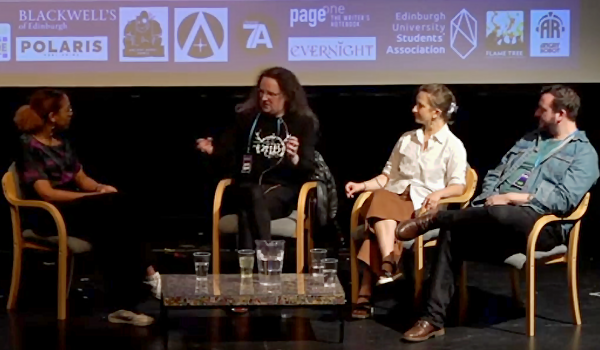
With Justin Lee Anderson and Sebastien de Castell. Hosted by E.M Faulds.
The panel started with readings from both authors. Sebastien de Castell started with a reading of The Malevolent Seven. He drew on his background in acting to bring the book to life, doing voices for all the characters in chapter one. He mentioned that when writing The Malevolent Seven, he wanted to see how many swear words he could fit into a book.
Justin Lee Anderson followed on with an excerpt from The Lost War, while commenting that it was hard to come after de Castell’s performance. He was definitely selling himself short, though, as he was just as good!
E.M. Faulds asked some great questions and got the authors talking about how they build the worlds of their novels. De Castell said that he builds a culture rather than a landscape and that fantasy lets him manipulate more, allowing him to build around a theme. When writing The Malevolent Seven, he doesn’t care if he offended anyone. (Add swearing bit). He is also a fan of Good Omens, and of the idea that human foibles will save us.
Interestingly, Anderson was also inspired by Good Omens, although his inspiration took a very different route, with him actually including “God” in a fantasy novel. Like de Castell, he wasn’t concerned with offending people, and The Lost War contains various conversations between faithful and faithless characters discussing religion. The religion in The Lost War is vaguely Christian-based and exists in a world alongside magic. I found the types of magic that Anderson listed to be very interesting as he’s included the types you’d expect to find in a fantasy novel, i.e. elemental, nature, illusionist, and animal magic. Then he’s added powers such as gravity, metamorph, and energy transfer magic.
Likewise, The Malevolent Seven has quite a wide array of magic as well, although with more of a focus on light and dark, as the religion in de Castell’s world is loosely based on heaven and hell. Fans of de Castell’s Spellslinger series will remember a certain animal character, and de Castell talked about there being another one in The Malevolent Seven. The jackal was actually one of the animals he sourced while researching Reichis for Spellslinger.
He continued with an interesting tidbit that Reichis was originally going to be racoon; however, Guardians of the Galaxy has just been optioned as a movie. If spellslingers were to ever be picked up as a script, Hollywood would never go for another talking raccoon. And that was how squirrel cats were born!
When asked what they’re working on next, Anderson said that book two, The Bitter Crown, is out in December, and he’s about to start work on book three. As for de Castell, he’s slowly writing a book called Our Lady of Blades, and he says it is the hardest book he has ever written. It’s the next Greatcoats book, which he said will be “his masterpiece”, and he joked that it will therefore probably get light-hearted reviews.
Ungodly Beginnings
With Ed McDonald, RJ Barker and Hannah Kaner. Hosted by Saara El-Arifi.
When Saara El-Arifi asked what the inspiration for their respective books was, RJ Barker noted that Gods of the Wyrdwood was supposed to be an easy, fast paced robin hobb rip off – but he failed miserably there. Hannah Kaner listed Terry Pratchett as one of her main inspirations for Godkiller, while Ed McDonald wanted to write a love letter to the books he loved as a kid, mentioning Robin Hobb and Kate Elliott.
Describing Daughter of Redwinter further, he did so as a what-if scenario; what if you had to become the dark lord through no fault of your own, for the good of everyone else? He continued by adding that, as a result, there is a large body count in the book. It’s set in pseudo-medieval Scotland with Scottish clans.
Barker referred to Gods of the Wyrdwood as a really violet Narnia with woods that make you feel like you need to get out of them. There is a North vs south theme with one representing winter and the other summer. The book is about being a chosen one and what happens when what you were supposed to do is taken away from you.
In comparison, Kaner’s book, Godkiller, asks what people do in the face of power. The discussion turned to the beautiful Godkiller cover, and Kaner told us that one idea that was discussed was one of the characters who has a fire heart. The idea was shut down quickly because nipples couldn’t be shown on a cover.
Saara El-Arifi turned the discussion to writing their characters, and Barker said that when creating characters, he considered that they should need and want something. His protagonist, Cahal, wants people to leave him “the fuck alone”, but what he really needs is a hug. Also, while in most fantasy books the characters journey somewhere, in Gods of the Wyrdwood, Cahal just stays in one place.
It was interesting to hear McDonald talk about creating a character with PTSD for Daughter of Redwinter, who had also had her emotions shut off by a character who is using her. He didn’t recognise that he was writing about emotional numbing in depression until a reader mentioned how they felt seen by it. He noted that it was very difficult to write a first-person perspective without any emotions, so she does feel some.
He adds that while this is a magic school story, Raine’s not a student; she’s a servant and therefore not allowed to be trained. But you can’t hold a good necromancer down, he remarked with a grin. His thinking for Daughter of Redwinter was along the lines of “how do you end up being Sauron?” because he didn’t start as a six-year-old thinking about world domination.
Kaner said that she originally was going to write Godkiller solely from Kissen’s point of view; however, she found that the story wasn’t rich enough with just one single perspective.
On the topic of research, the authors all answered very differently, with Barker explaining that he liked to get specific answers to questions. When he was writing The Bone Ships, he needed to know what wet bones smelled like, and it took him forever to get an answer, which was nothing. McDonald stated that the reason he wrote fantasy was so that he could avoid research; however, this came back to bite him when he used Gaelic to make some of the language in Daughter of Redwinter without doing any research. When the audiobook was being recorded, he had to research the pronunciation. Whereas Kaner happily declared her love for research and falling down research rabbit holes.
Later, an audience question asked the authors how they keep from getting sucked into research, and Kaner explained that you have to keep researching, but as a writer, you know that your purpose is to write. You know that you can’t know everything and that you have to write.
Each of the authors’ books involves gods in one way or another, and when asked whether people or gods came first when worldbuilding, both Barker and Kaner said that people came first. Kaner added that, specifically, it was what people believed in, with Barker agreeing that it was about gods reflecting people. McDonald said that he hasn’t included gods as characters in Daughter of Redwinter, but he does reference them.
This was an excellent panel hosted by Saara El-Arifi.
Underworld
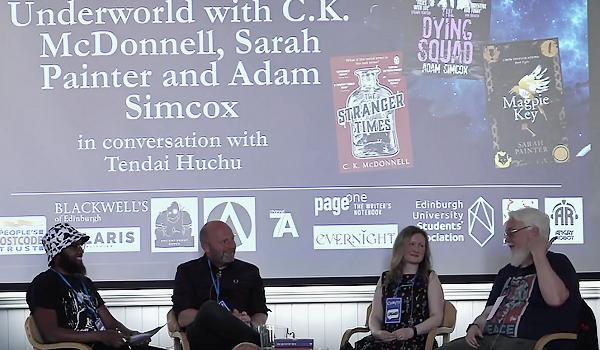
With C.K. McDonnell, Sarah Painter and Adam Simcox. Hosted by Tendai Huchu
The panel was hosted by author Tendai Huchu, who began by introducing the authors and coining the phrase “bonkers lit” to describe their books; a book where the reader suddenly finds that they’re strapped onto a rocket while reading it. Having read two out of three of the book series discussed on this panel, I have to say it’s a pretty accurate description!
While each of the authors writes in the genre of urban fantasy, they have all brought their unique spin to it. Adam Wilcox explains that The Dying Squad is about a detective who has to solve his own murder, who joins the spectral squad, a squad that solves murders that living cops can’t. He said that the bodywork is urban fantasy, but it’s also a crime novel. He previously had a career in filmmaking, but got fed up with always hitting a budget. In comparison, when writing books, he explained that the only limit is talent or imagination. He finds it much more liberating.
The Stranger Times series is set in Manchester and features the staff of a fictional newspaper that finds out that the weird world they report is actually real. McDonnel was going to write a “serious crime”, but on a walk, he got inspired and ended up using ideas from an old sitcom script he had lying about. He often gets asked whether he worked in newspapers due to the accuracy in his novels; he never has and actually stole all his research from TV shows. He told us that he likes making ridiculous crap up too much, but now he gets paid for it!
Painter described The Crow Investigations series as urban fantasy with crime running through it. Admitting that she finds it hard to stick to one genre, she said that all her books have some magic in them somewhere, whether it’s a ghost or something supernatural. The idea for the Crow Investigation series came to her when she was in London. It just came out of nowhere and was a solid fantastical story.
The discussion turned to character names, and McDonnell disclosed that he struggles with naming characters, something that readers don’t realise is really difficult. He explained that he looks around his office for names, which isn’t helpful, as he ends up finding his own books. So instead, he starts using the names of the Irish Rugby team, a tactic he has used so many times that he ends up doubling up on names. His wife ends up going through drafts and renaming characters. In the Dublin Trilogy, he used names of famous comedians in the draft, with the intention of changing them… and then forgot to change them.
Painter agreed when it came to names, saying that her brain gets stuck on one letter, so she has to go back and rename characters as well. In The Dying Squad, Simcox chose a biblical name for his protagonist, Detective Inspector Joe Lazarus, to be purposefully tongue-in-cheek. In comparison, Joe’s spirit guide, Daisy-May, is the total opposite and is a juxtaposition to her being from a council estate in Nottingham.
Huchu was a wonderful host, asking great questions and drawing great comparisons between the three series. Family is one of them. On this topic, McDonnell described The Stranger Times as a found family, although he admitted that while Bancroft is fun to write, he is a monster. For Painter, families are interesting to write about, as most of us have one, whether it’s biological or a found family. But families are not always sweetness and light; they’re also about duty, and that’s a key part of The Night Raven. Her protagonist, Lydia, was brought up away from her family, the Crows, and their criminal enterprises. She’s been sucked back in, and as Painter pointed out, duty is something that a lot of us can relate to. Lydia learns her own power, but also just how dodgy the Crow family is.
For Simcox, families come with secrets and lies, and there’s plenty of both in The Dying Squad. After his death, Joe doesn’t remember who he is or how he died, and Simcox hinted that the truth isn’t going to be positive. While Joe has a difficult relationship with his dad, Daisy-May didn’t have any parents, and her grandmother was the parental figure in her life. They form their own new family together. This is something that we all do aswe get older, Simcox remarked; family is what you make it.
A fun audience question for the authors was who would you cast as your protagonist:
- Adam Simcox named Paul Bettany as Joe
- Sarah Painter named Kristin Ritter as Lydia
- C.K. McDonnel named Dylan Moran as Bancroft
Buy the Books
Over to you
Thanks for reading the CYMERA book festival 2023 recap and review! I hoped you enjoyed this post, and if you would like to see more about CYMERA, you can check out my post about CYMERA 2022 and CYMERA 2021!
Support Just Geeking By
I hope you enjoyed this post! If you did, please consider sharing it on social media using the nifty buttons at the end of this post <3
If you enjoyed this content, please consider supporting my blog. You can do this in multiple ways (click here to find out how!) or by donating via Ko-Fi to help me reach my current goal.

Discover more from Just Geeking By
Subscribe to get the latest posts sent to your email.