


Published by Piaktus
Age Group: Adult
Format: Fiction
Genres and Categories: Disabled and Neurodivergent Authors, OwnVoices Representation, Magic Users, Dragons, Chronic Illness, Trauma, Action, Adventure, Dragon Fantasy, Romantasy, Various Magic
Series: The Empyrean #1
My Rating:

Published on: 2nd May 2023
Pages: 528
Disability Representation: Anxiety, Chronic Pain, Hypermobile Ehlers-Danlos Syndrome (hEDS), Suicidal Ideation.
Buy this Book! Amazon UK / Amazon US / Barnes & Noble / Blackwells / Forbidden Planet / Bookshop.org US / Bookshop.org UK / Waterstones / BookBeat Audio
Add to Goodreads
Enter the brutal and elite world of a war college for dragon riders from #1 New York Times bestselling author Rebecca Yarros
Twenty-year-old Violet Sorrengail was supposed to enter the Scribe Quadrant, living a quiet life among books and history. Now, the commanding general—also known as her tough-as-talons mother—has ordered Violet to join the hundreds of candidates striving to become the elite of Navarre: dragon riders.
But when you’re smaller than everyone else and your body is brittle, death is only a heartbeat away...because dragons don’t bond to “fragile” humans. They incinerate them.
With fewer dragons willing to bond than cadets, most would kill Violet to better their own chances of success. The rest would kill her just for being her mother’s daughter—like Xaden Riorson, the most powerful and ruthless wingleader in the Riders Quadrant.
She’ll need every edge her wits can give her just to see the next sunrise.
Yet, with every day that passes, the war outside grows more deadly, the kingdom's protective wards are failing, and the death toll continues to rise. Even worse, Violet begins to suspect leadership is hiding a terrible secret.
Friends, enemies, lovers. Everyone at Basgiath War College has an agenda—because once you enter, there are only two ways out: graduate or die.
The Empyrean series is best enjoyed in order.
Reading Order:
Book #1 Fourth Wing
Book #2 Iron Flame
Book #3 Onyx Storm
Content Warnings:
Please note
As an Amazon Associate and member of other affiliate programmes I earn a small commission from items purchased using links featured in this post at no extra cost to you. Click here to learn more.
Every purchase you make through Just Geeking By helps keep this blog running.
Fourth Wing Review
By the time I got around to reading Fourth Wing by Rebecca Yarros, I had read various perspectives on the plot and the disability representation in the book. That includes the brilliant guest post that Ella T Holmes wrote for GeekDis 2023, Fly Or Die: The Ableist Narrative of Toxic Perseverance.
When it comes to overly popular books, I don’t tend to be swayed by popular opinion. I read books based on my interests. I have heard so many mixed responses to Fourth Wing by Rebecca Yarros that normally, I would avoid it. However, it has Ehlers-Danlos Syndrome (EDS) representation, which is so rare in fiction, especially science fiction and fantasy, that I wanted to check this one out for myself. I would have checked Fourth Wing out as I like to review books with disability and neurodivergent representation to provide reviews for members of our community, anyway, but this representation is particularly relevant for me as I have hypermobile EDS (hEDS). There are currently thirteen types of EDS, hEDS being one of them, and for those who know about the condition, please visit the Ehlers-Danlos Society website for more information.
Fourth Wing tells the story of a twenty-year-old woman who had prepared all her life to become a scribe. On the day that Violet is about to enter the Scribe Quadrant and begin her studies, her life is turned upside down by her mother’s decision that she will be joining the elite dragon riders instead. Her mother is a General and the commander of the Basgiath War College, where dragon riders are trained. Violet’s choice doesn’t matter; no one will go against her mother’s wishes, and she wants her daughter to follow in her siblings’ footsteps.
The problem is that Violet’s body isn’t like everyone else’s; it’s weaker and injures easily. Her joints dislocate and sublux (partially dislocate or displace), and the War College is a dangerous enough place without being at such a physical disadvantage. It’s a death sentence, and her chances of even surviving the harsh crossing to even reach the College are slim.
When she makes it over the parapet, Violet finds herself in an environment that’s hostile in multiple ways. It’s not just the training, it’s the other riders who think she’s a liability for being weak, who hate her for her mother’s past actions, and then there are the dragons themselves. Powerful creatures who are more likely to incinerate her on the spot than bond with a “fragile” human.
Will Violet survive the harsh life of Basgiath and become a dragon rider like her family before her, or will her body fail her?
The first thing I noticed about Fourth Wing was how utterly blasé Yarros was about death from the onset. The danger of Basgiath, especially for someone as “weak” as Violet, was implied over and over again and backed up by the constant deaths of characters. It made it impossible for me to become emotionally attached to any character in the book because Yarros did not discriminate. It didn’t matter if they were a minor character, an unnamed NPC or a main character; everyone was fair game.
Not being able to become attached to a character was not the only issue I had with Yarros’ constant obsession with killing characters off. It was one of several major plot holes that I came across in Fourth Wing. The dragon riders are elite warriors, and their training is intense, to the point that they are killed during it. Got it. However, that makes no sense when you think about it. The whole concept of the world that Yarros has built is that the dragons bond with riders to keep the realm safe from a serious threat. How does killing off hundreds of students help achieve that? It’s counterintuitive and extremely wasteful of potential warriors who could train in other fields and still help protect the land.
Especially when you take in how they “train”, and I use that term extremely loosely as there appears to be no physical training. The only physical training takes place in the form of sparring matches, and there is no directed learning. During these sparring matches, the rules are extremely loose, with one particularly violent student killing another through excessive force.
The students do not learn fighting styles; their skills primarily come from the knowledge that they bring with them before entering Basgiath, which they refine during the sparring matches. The dog-eat-dog environment pits students against each other, preventing them from learning from each other. After all, you don’t want your competition to have an upper hand.
While that all makes for good drama, again, it makes little sense for a military academy. It often feels that at every turn in Fourth Wing, Yarros is determined to handicap her characters rather than give them the tools to help them survive. This harsh and violent setting fuels a trope that I feel is the foundation of Fourth Wing: the chosen one.
Yarros reminds us at every turn that Violet is weak, that she’s fragile, and uses the constant barrage of death to drive the point home that we’re just one page away from our heroine failing. Of course, as the protagonist, we all know that is never going to happen because otherwise, it will be a very short book, which is what makes the constant commentary from Yarros even more ridiculous. It actually becomes offensive and ableist because it honestly feels as though the author herself doesn’t believe that her heroine, a disabled woman, can do anything.
But she’s weak, she has a chronic illness, I hear you cry! Yes, that means she’s at a disadvantage, and yet other authors writing characters with chronic illnesses and disabilities somehow manage not to write a book where they are putting their character down on almost every page. It reeks of internal ableism, and I’m not talking about Violet’s. This is what bothered me the most about Fourth Wing: the constant implication that someone who is clearly not weak and is surviving while her stronger classmates are dying around her is weak and fragile, JUST because she has a disability.
If Yarros had simply gone with Violet, managing the difficult task of surviving and excelling, then that would have been one thing. Instead, Violet is the ‘chosen one’, who continuously defies the odds. With one year of physical training, she manages to survive the obstacle course, while another character who has been training on them since childhood fails. She manages the impossible, doing something that has never been done in the history of dragon riders. It was also incredibly obvious from the moment that something rare was mentioned that it was going to end up involving Violet.
Concerning EDS representation, I felt that there wasn’t much of it. As with every book I’ve read so far that has EDS representation in it, Fourth Wing, as someone who has hEDS, I did not feel that the book represented the full variety of symptoms well. Specifically, just how painful and all-encompassing Violet’s condition actually is. EDS affects every moving part of a person’s body, which includes joints, ligaments, muscles, and tendons. So imagine just how much damage Violet was doing to hers while training.
I think that the lack of understanding of her condition is extremely noticeable by the number of readers who downplay her disability in their reviews or appear not to even notice it. Ableism accounts for some of this, but I think the way that Yarros has chosen to focus on Violet’s being weak rather than taking the time to describe Violet’s symptoms and EDS-related injuries (she gives them a sentence or two at most) plays a large part.
Of course, Fourth Wing is a fantasy novel, and Violet’s condition is not given a specific name. We only know it is based on EDS from Yarros’ telling us this, but as she has the condition herself, I would have liked to have seen a better representation.
Only twice in Fourth Wing does Violet use her hypermobile body to her advantage, and yes, being hypermobile has advantages. It isn’t all about pain, weakness and fragile joints, despite what Yarros would make you believe. For example, having loose joints means that people with EDS can bend in ways that normal people can’t (reaching the middle of your back is very handy!). As such, that should have given Violet an advantage in many sparring matches. Only one time does Yarros seem to remember this and have Violet twist out of a hold in a fight. During a big fight scene, Violet uses her intimate knowledge of joints and their weaknesses to injure an opponent. This made me chuckle because people with chronic illnesses do have a much better understanding of bodies and their weak points due to our lived experience.
Ella T Holmes wrote about toxic perseverance in her guest post Fly Or Die: The Ableist Narrative of Toxic Perseverance for GeekDis 2023, an annual event I run about disability representation (it has been wonderful to see so many reviews linking to this, so thank you!). As Ella points out, many of Violet’s activities are high impact, and that wording is deliberate. When I was first diagnosed as a teenager, I was told to avoid high-impact activities at school as they could damage my joints – I was thrilled, I hated sport, so I had essentially been given a legitimate excuse to avoid doing them. Yet Yarros has written a book where everything her protagonist does is high impact, and yet she’s still surviving.
While Yarros offers explanations for Violet avoiding treatment at every turn, we have to remember that she is the author and could have quite as easily done the opposite. Every time I found myself scratching my head at Yarros’ authorial decisions in this book more than I have in any other book, and that includes the ones I’ve DNFed.
On top of all this, we also have Dain, Violet’s childhood friend, who spends his every waking moment trying to convince Violet to quit and become a scribe. His every action is toxic, and there are so many red flags.
Despite all these reservations, I’ve given Fourth Wing by Rebecca Yarros three stars. It’s not the worst book I’ve ever read, and beneath the plot holes and issues I have with the representation, there were parts that I enjoyed. Essentially, the parts with the dragons. If I could have skipped out on all the constant deaths and just got to the part with the dragons, then I’d have been good. The conversations with Violet and her dragon were hilarious; who doesn’t love a grumpy old dragon?
One final thing I do need to say is that I’m not quite sure why people say this book is so steamy. I went in expecting sex scenes galore and was very surprised by how little there was. There is a lot of sexual tension, but not that much action compared to other books I’ve read.
Will I read the next book? I don’t know. If my library gets it in, then I might, but I’m not going to go looking for it.
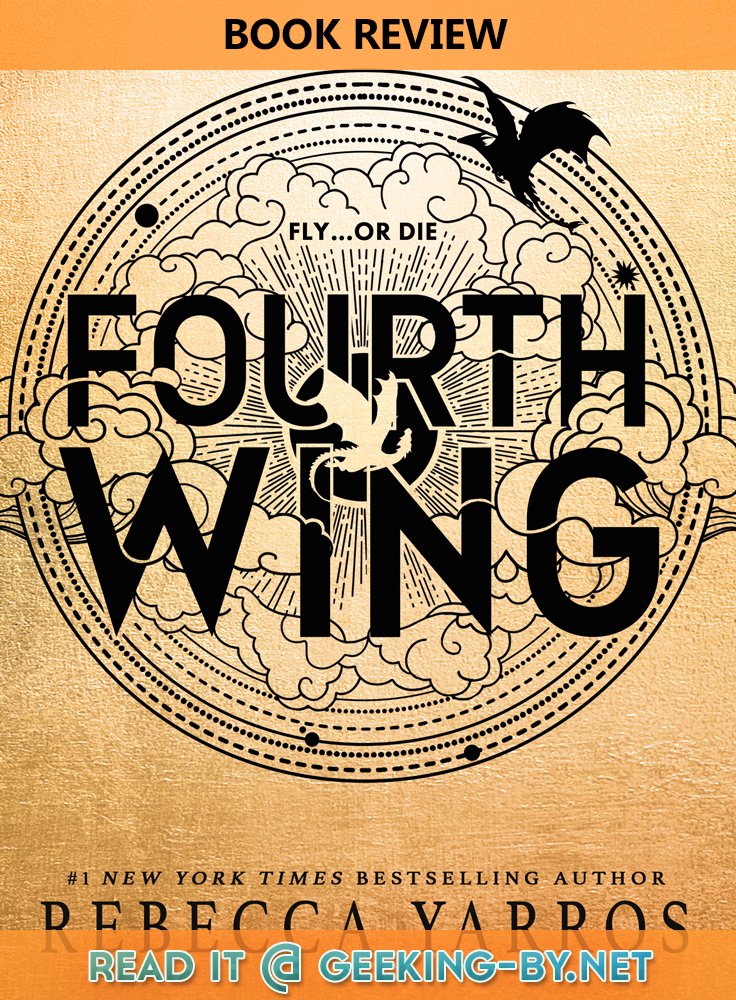
Thanks for reading my book review for Fourth Wing by Rebecca Yarros!
Don’t forget to check out the rest of my reviews if you’re looking for some more book recommendations 🙂 You can also now sign up for my newsletter to get an email each month with a list of my new reviews!
Support Just Geeking By
I hope you enjoyed this post! If you did, please consider sharing it on social media using the nifty buttons at the end of this post <3
If you enjoyed this content, please consider supporting my blog. You can do this in multiple ways (click here to find out how!) or by donating via Ko-Fi to help me reach my current goal.

Discover more from Just Geeking By
Subscribe to get the latest posts sent to your email.