

Published by Del Rey
Age Group: Adult
Format: Fiction
Genres and Categories: Cryptids, Horror Thriller, Supernatural, Survival Horror, Sci Fi Action, Sci Fi Adventure
My Rating:

Published on: 28th December 2024
Pages: 286
Buy this Book! Amazon UK / Amazon US / Barnes & Noble / Blackwells / Bookshop.org US / Bookshop.org UK / Waterstones
Add to Goodreads
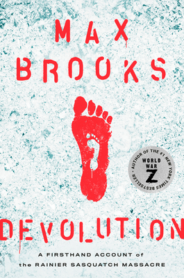
As the ash and chaos from Mount Rainier's eruption swirled and finally settled, the story of the Greenloop massacre has passed unnoticed, unexamined . . . until now. The journals of resident Kate Holland, recovered from the town's bloody wreckage, capture a tale too harrowing--and too earth-shattering in its implications--to be forgotten. In these pages, Max Brooks brings Kate's extraordinary account to light for the first time, faithfully reproducing her words alongside his own extensive investigations into the massacre and the legendary beasts behind it. Kate's is a tale of unexpected strength and resilience, of humanity's defiance in the face of a terrible predator's gaze, and, inevitably, of savagery and death.
Yet it is also far more than that.
Because if what Kate Holland saw in those days is real, then we must accept the impossible. We must accept that the creature known as Bigfoot walks among us--and that it is a beast of terrible strength and ferocity.
Part survival narrative, part bloody horror tale, part scientific journey into the boundaries between truth and fiction, this is a Bigfoot story as only Max Brooks could chronicle it--and like none you've ever read before.
This book was provided for free by the Publisher and the publishers in exchange for an honest review. Many thanks to the publisher and the author for the opportunity to read this book!
Content Warnings:
Please note
As an Amazon Associate and member of other affiliate programmes I earn a small commission from items purchased using links featured in this post at no extra cost to you. Click here to learn more.
Every purchase you make through Just Geeking By helps keep this blog running.
Devolution Book Review
Devolution is quite different from my normal reads. I have to be honest, it was Max Brooks himself that piqued my interest in this one. I’ve never been interested in cryptids that much, especially not Bigfoot. But hearing the author himself talk about his inspiration for the novel and what he hoped people got from it at the Del Rey 2021 Virtual Showcase was so interesting that I had to read this one for myself. what intrigued me about Devolution was the way Max Brooks talked about it at the Del Rey Virtual Showcase. During his interview, he was asked what he hoped people got from his books, and the way he talked about using fiction as an educational tool was quite inspiring. I wanted to see for myself what he had done with this book to bring science and useful information to people via a fictional format. I’ll be honest, I’m not that curious about Bigfoot in general so I’m going into this with very little knowledge of that mythos. That’s going to give me quite an interesting standpoint I think.
The first thing that I noticed about Devolution was how flawlessly Brooks writes from a female perspective. I was able to slip into the mindset of Kate Holland easily without recognising that it was a male author writing a female character. You’re probably thinking that gender shouldn’t play a role and you’re right, it shouldn’t. But I’ve read some truly awful books written by male authors with female protagonists where it’s clear that it’s important to them and was on their minds when they were writing the book. In the case of Devolution, Brooks’ narration just flowed completely naturally. Whether it was from Kate Holland’s journal entries or interviews with her brother or Senior Park Ranger Josephine Schell.
The bulk of the book is made up of Kate’s journal entries and told from her perspective, with each chapter packaged with interview snippets to add context. It’s like watching a film; you get to see what every character is doing. Unlike a film, this is set up like a documentary with Brooks acting as a researcher who is putting all the evidence together in one book. Even the synopsis reads as though this is a real encounter that happened, and considering the level of research he has put into this book, it’s quite easy to believe it. The Greenloop community does not seem to exist – yet. Sustainable living communities are already happening worldwide and that’s not the only piece of real-life information that Brooks has woven into his story. The USGS’ (The US Geological Survey) budget was cut under the previous Presidential administration, putting lives at risk as Brooks discusses in the novel and the new US administration is putting money back into it in 2022 for just that reason.
In general, I was quite impressed with how many random facts and thought-provoking points Brooks managed to ease into the narrative without seeming as though he was flooding the reader with facts. Unlike hard science fiction authors, everything came naturally as part of the character’s design and conversation. Greenloop is not a prototype, but it is the first of its kind created by the Cygnus company and it’s not cheap to get a house in the community. The residents are primarily academics, people who don’t need to live in the city to work and have made a fortune being smart. It provides Brooks with the perfect platform to offer information to the reader without seeming as though that is exactly what he is doing.
There were a few things that bothered me about the book and the first is the format of Kate’s diaries. She writes down word for word every single conversation she has with her neighbours, and I’m sure some readers probably thought “Ah well, she’s just got a really good memory!” and excused it. The problem for me is that I do have a really good memory, as close to a photographic/eidetic memory as possible (spoiler: no one has a fully photographic memory, no one’s Batgirl). Even if you can remember the majority of a conversation you can’t remember it word for word. If you were writing in your diary it would be more like “And then Joe Bloggs said something about the weather and Mary Sue was like, well the news reports are always wrong….”. There’s a degree of uncertainty, in ad-lib. It’s not word for word perfect which is what is exactly what is found in Devolution. The interviews are written with more realism, it’s just the diaries that are too perfect and read like fiction.
It broke the illusion that this might have happened even more for me, which in turn meant that I couldn’t really take any of it seriously or become connected with the characters. That leads me to my other biggest issue; how they choose to defend themselves against the monsters. Brooks does an excellent job of explaining why certain methods of defence are not possible, however, other very obvious ones are completely ignored in favour of going for the most bloody stereotypical horror survival showdown. We already know a massacre happens; it’s in the book synopsis. So readers expect it. It’s why they picked up the book and Brooks delivers it. It’s well written, it’s terrifying and I’m still sitting there reading it thinking X why didn’t they use that?! Perhaps that is Brook’s entire point; when faced with a predator that puts us lower down on the food train we stop thinking like an intelligent and resourceful species as devolution takes place.
In a way being who and what I am, someone with an academic and research background, I ruined this book a little for myself. While fact-checking some of the auto-searches that kept popping up were “Did the Green Loop Massacre happen?” and “Is it real?”. I didn’t check that, I went straight to Mount Rainer’s wiki page and checked when it last erupted. I also googled GreenLoop to see if it existed. As soon as I knew those two key pieces of information were false I knew that the rest was elaborate fiction, and that takes away a huge part of the magic of Devolution. Brooks’ craft is writing believable docu-drama fiction, and if I hadn’t known any better I would have been sucked in. The huge amount of research that has gone into this book is amazing, and then you get to the character creation. Every single character is unique, and completely believable, including the witnesses that Brooks interviews. The Senior Ranger Josephine Schell especially is written so well that I wonder if Brooks did interview a ranger from the United States National Park Service as part of his research for this book.
Despite knowing that the massacre is not real, I came away from Devolution educated. I learned things which is what Max Brooks wants. I learned that coconut water is the best natural hydrator in the world, for example, which I never knew. I learned about homes being built from recycled materials and got curious enough to look to see whether they had already become a reality. I’m sure I won’t be the only one, so I got plenty from Devolution even if I wasn’t a huge fan of the story. So give it a shot, see what you learn 🙂

About Max Brooks

Max Brooks is The New York Times bestselling author of The Zombie Survival Guide and World War Z. He has been called ”the Studs Terkel of zombie journalism.“
Brooks is the son of director Mel Brooks and the late actress Anne Bancroft. He is a 1994 graduate of Pitzer College. His wife, Michelle, is a screenwriter, and the couple have a son, Henry.
Over to you
Thanks for reading my review for Max Brooks’ Devolution! I considered skipping the research elements of this review but that would not have been true to my experience as a reader.
Have you read Devolution? What was your experience of the novel?
Support Just Geeking By
I hope you enjoyed this post! If you did, please consider sharing it on social media using the nifty buttons at the end of this post <3
If you enjoyed this content, please consider supporting my blog. You can do this in multiple ways (click here to find out how!) or by donating via Ko-Fi to help me reach my current goal.

Discover more from Just Geeking By
Subscribe to get the latest posts sent to your email.