

Hello everyone! It is my pleasure to welcome author Ella T. Holmes back to Just Geeking By to guest post for this year’s repDISND. Her guest post last year, Fly Or Die: The Ableist Narrative of Toxic Perseverance, has been immensely popular and this year she’s joining us to talk about disability self-erasure!
Please read on for Ella’s full guest post ‘Unearthing the Self: A Story of Fossils, and Disability Self-Erasure’!

Every purchase you make through Just Geeking By helps keep this blog running.
Picture me, just a silly goofy girl living a silly goofy life, looking my novel right in the eyes and wondering, for the first time, if I could write a protagonist with a disability. Picture me, born with multiple disabilities/conditions, realising at the ripe young age of twenty-one that in all my years of writing and coming up with stories, I had never, not once, considered writing myself and people like me into them.
To use a creative metaphor, it felt rather like being a plant-eating Brachiosaurus and realising you’d only ever written stories that centre, prioritise, and heroise the carnivorous, steak-loving Tyrannosaurus rex—a rather dramatic visual motif, I’ll admit, and in no way am I saying non-disabled people are monsters. Just that we live different lives, one of us has more power than the other, and it is most often disabled people who are harmed at the hands of the dominant power (as opposed to the other way around, a common misconception ((Australian Institute of Health and Welfare. (2024). People with disability in Australia. Retrieved from https://www.aihw.gov.au/reports/disability/people-with-disability-in-australia)) ).
I bring up dinosaurs because I love them, and also because I think the archaeology and history around them ties in well to this experience. When I think of dinosaurs I naturally think of fossils. All that history, buried. Lost, over time, and found again.
At the age of twenty-one I was experiencing a discovery of my own, a sudden chiselling-out of an idea that had always been buried somewhere in my subconscious. In this scenario, I am the archaeologist in charge of the dig, but it’s kind of like I was underqualified and didn’t know I was looking for anything until I realised I was dismissing something cool as something mundane and useless as rock.
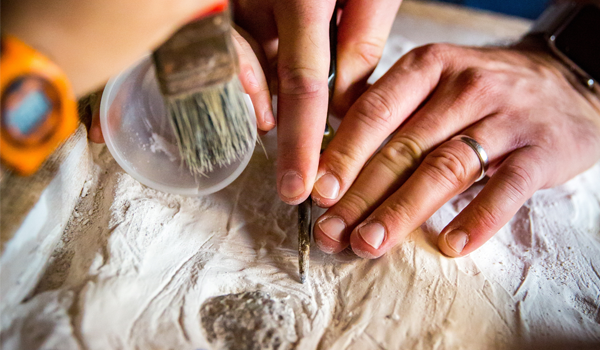
Before posting the question online, I had spoken to several writers with disabilities who have shared this exact moment at various points in their lives, to varying degrees of questioning, and so I had to excavate the phenomenon.
I posted on Twitter about this, raising the question if any other disabled creatives have gone through the same “moment of awakening”. My experience had me sitting at a rainy window looking at my reflection (picture it like a music video, and it might seem cool), thinking “What if I made my protagonist disabled?”
Then, “What if I gave them my disability?”
Then, “Can I do that?”
Then, finally, “Why haven’t I ever thought to do that before?”
I was both happy and sad to know that there are a fair few of us who relate to this moment of clarity and questioning, this moment where the layers of sediment are removed and we see the potential for ourselves in stories for the first and or most meaningful time.
There is a certain kind of grief that accompanied this sudden discovery of self—or rather, the absence of self. For so long I had been engaging in something which likely has a name but which I’m calling disability self-erasure, which refers to this act of not seeing, of never even considering myself or my body to be story-worthy, of not making space for myself and my identity in fiction. ‘Self-erasure’ on its own is a term I first heard in therapy, which also refers to the minimising of one’s self and needs, which feeds into imbalanced power dynamics, all of which is also relevant here.
In my experience, it was as if I and people like me didn’t exist, like I just did not recognise it as a fact. And that’s wild, because I’m right here! I exist in this body! How many times had I wanted to write but couldn’t focus because of my chronic pain? How many times had I fought through the pain of a shoulder subluxation in order to go to the movies and consume stories, or carry library books? How many times have I popped out a finger while holding a hardcover or winced when a superhero had their shoulder dislocated? In this way, stories and storytelling have been directly impacted by my disability, and yet it still never occurred to me to write a character with Ehlers-Danlos into my own worlds and narratives.
Because I didn’t grow up seeing myself and people like me in media, I didn’t know we could do that. It taught me, over years and years, to not consider myself in the creative process. I was defaulting to stories of able-bodied male soldiers and able-bodied princesses (so too there is a gendered aspect). I was writing stories about sentient eyeballs and shape-shifters and dragons and … All that, before considering the real body I and many others inhabit. All that, because they seemed more real? More interesting? More natural? More normal? Perhaps all of the above.
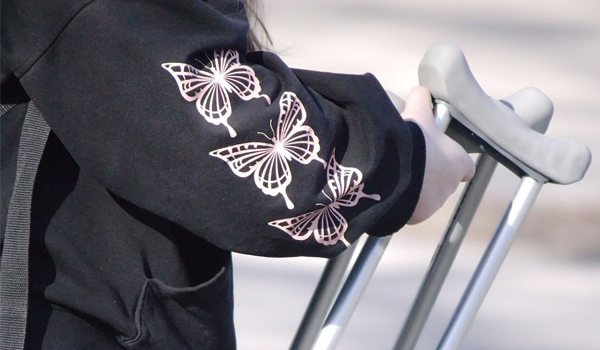
In a world that consistently dismisses, erases, and undervalues disabled people and disabled people’s perspectives, to know that I too had been engaged in that in some way, was heartbreaking. The more I’ve learned about disability justice, the more disability studies I’ve engaged in, and the more disability advocacy I’ve become involved in, the clearer it’s become to me just how thoroughly we’re taught to commit disability self-erasure—in such a way as to not know we’re doing it. The fossil doesn’t know it’s being buried, it just is. The bone doesn’t know it’s being worn smooth by pressure, it just is.
But we are not so static, and we need not wait for discovery.
While sediment actually protects the to-be-fossil remains from things like scavenging animals, decay, and erosion, the able-bodied supremacist system only claims to be protecting us (disabled and non-disabled alike). It is in actuality the scavenging force, and that erosion and decay they’re pretending to protect us from is actually being caused by our current systems, infrastructure, and ideologies. We are not objects. Though we exist within the layered power structures which bury us and put non-disabled bodies above our own, we have the power to try to sift through the suppression of our voices and experiences.
We can and should tell our stories, tell stories with people like us in them, tell stories that centre us. (Publishing and whose voices are given the stage is a whole other can of worms. For now, I just want to say that we have permission. Twenty-one-year-old me needed that.)
Unfortunately, this is not the end of the story of self-erasure. It has long-reaching fingers, and patterns that need breaking. In my studies and readings on disability representation in media, it’s become apparent to me that even when people with disabilities begin to exercise their right to tell stories, sometimes we (including me!) fall into patterns of storytelling which still centre the non-disabled body and non-disabled experience.
It was at first surprising to me to see that creators with disabilities were some of the people who were writing narratives which centre the abled experience or uphold able-capabilities—for example, writing a story in which disabled people overcome their symptoms and disability in order to be heroes—but it actually makes sense. I was doing the same thing, in never giving any character a disability, and in my fumbling first attempts to include them. We are raised in, steeped in, an ableist system; we are water drawing tea from a bag; it shouldn’t shock us to know that people with disabilities can perpetuate ableism like anyone else ((Pulrang, A. (2020). Words Matter, And It’s Time To Explore The Meaning Of ‘Ableism.’ [online] Forbes. Available at: https://www.forbes.com/sites/andrewpulrang/2020/10/25/words-matter-and-its-time-to-explore-the-meaning-of-ableism/.)). We are human, after all. When we don’t see ourselves, or when we see ourselves only in stories which tell us we shouldn’t want to be disabled, we internalise that, and it can reflect in our work. Sometimes this is entirely subconscious. Sometimes these narratives of overcoming are intentional power-fantasies (to which I ask the question: why is the fantasy always that we overcome our bodies and our exclusion from society, as opposed to society changing to accommodate us and see our value?).
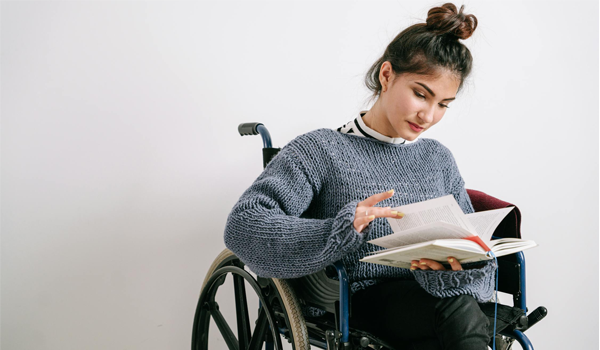
It is important to acknowledge that not all disability “representation” is going to hit in the same way for everyone, non-disabled or disabled. We’re not a monolith and this essay is not an attempt to say any specific disability narratives are inherently bad or worthless. In fact, the ‘supercrip’ trope/narrative is very common in film, books, and journalism, and while I personally don’t like it, for many disabled people it can feel empowering and liberatory. Such is the nuance and complexity of the human experience.
This socially-taught disability self-erasure has many effects. It means that, to give a few examples, disabled creatives might never write about themselves/disabilities, may write disability through an able-bodied lens, maybe write disability in a way that upholds ableist rhetoric, may write disability in a way that seeks to be “inspirational” but which falls back on the perpetuation of misinformation and harmful misbeliefs. They may also forget that other disabilities exist even in worlds that necessitate them existing (take a fantasy novel centred around war, a mass-disabling event, and wonder why there are often no disabled characters to speak of). Ableism is not a system of oppression which harms only the disabled; it harms many others as well and compounds many different inequities ((Yancy, G. & Lewis, T. (2023). Ableism Enables All Forms of Inequity and Hampers All Liberation Efforts. Retrieved from: https://truthout.org/articles/ableism-enables-all-forms-of-inequity-and-hampers-all-liberation-efforts/)). It’s vitally important we do the work to recognise this, and do the work to unlearn what we’ve been taught is acceptable, “normal”.
In essence, layer by layer, tool by tool, we must dig until we get to the subsoil, the layer without man-made oppressive artefacts—we must find the layer, the common ground, which says we are all human. It will take time, and discomfort. No fossil was ever found without a little effort. It is a process we all must undergo.
It may seem overly-serious or hard-phrased, but in many ways we are indoctrinated (taught to think uncritically) into able-bodied supremacy. Most people learn about disability primarily through media like TV, film, and books ((Harris, L. (2002). Disabled sex and the movies. Disability Studies Quarterly, 22(4),1–19. https://dsq-sds.org/article/view/378/503.))—all industries shaped by the dominant group and their beliefs about disability ((Haller, B. (2010). Representing disability in an ableist world. Essays on mass media. The Advocado Press, Inc.))—and if most people are learning about disability through that, it should come as no surprise that most people hold misinformed opinions about us (people with disabilities). It was a shocking moment when I asked a friend why they thought I could “just ignore” my chronic pain, and they answered that they’d “seen it on television, and it doesn’t seem that bad because people get used to it. And anyway, shouldn’t you have a high pain tolerance?” It was downright frightening to experience a similar moment with a medical professional.
So, it is my hope for the future that we see more disabled stories by disabled creatives on bookshelves, in cinemas, on streaming platforms, and more. It is my hope for the future that together, as a community, we can unearth the metaphorical fossils of our identities and see that they are inherently valuable and that our stories and our identities deserve to be reflected in fiction. It is my hope that future generations, with access to these stories, will grow up without the shame and internalised ableism that I did.
I wonder what person I might have been, or how I might have thought about myself and my body, if I had those stories in my formative years. If I had seen, instead of the stories which call me lazy or unimportant or used as metaphor, narratives in which I am considered real and whole and inherently valuable, what might that have been like?
I don’t want to have to continue consuming buckets and shovelfuls of stories and sifting them for evidence that I exist, to have to waterscreen for tiny beads and seeds of “representation”. I want to be the grand discovery, the story. I want to be the discoverer, the writer. I want us to all unearth ourselves, to play show-and-tell and appreciate our value.
About the Author
Ella T HolmesElla T. Holmes always dreamed of being a Mad Hatter or a cunning princess who is definitely not a witch, but reality intervened. Fortunately, she’s got a knack for escaping it. Born and raised around Australia, Ella spends her time patting cats, drinking coffee, and occasionally having thoughts. Her work has been published in or is forthcoming in Coffin Bell Journal, Orca, Antithesis, and Macfarlane Lantern Seasonal Anthologies, among others.
You can find out more about her work by following her on Substack and her website.
Over to you
Many thanks to Ella for her excellent post about disability self-erasure! Ella is currently editing a Disabled Fantasy Anthology, and you can sign up for updates about it here.
Did this post resonate with you?
Have you struggled with disability self-erasure?
This review is part of repDISND (formerly known as GeekDis) an annual event I run for the disabled and neurodivergent community to discuss representation. Follow the hashtag #repdisnd or follow me on social media for more!
Support Just Geeking By
I hope you enjoyed this post! If you did, please consider sharing it on social media using the nifty buttons at the end of this post <3
If you enjoyed this content, please consider supporting my blog. You can do this in multiple ways (click here to find out how!) or by donating via Ko-Fi to help me reach my current goal.

Discover more from Just Geeking By
Subscribe to get the latest posts sent to your email.